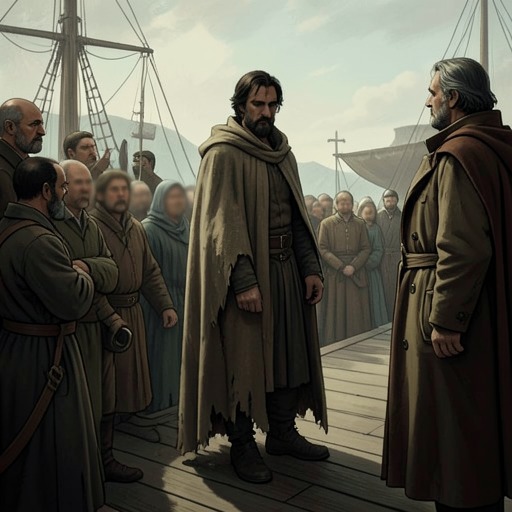
Hardquanonne
The Man Who LaughsHardquanonne is the Fleming whose specialized operation transformed Lord Fermain Clancharlie, as a child, into the boy later known as Gwynplaine. His work was meant to make the child a laughing mask, but the imposed smile becomes the mark that identifies Gwynplaine and evidence of royal violence. Years afterward, a gourd bearing Hardquanonne’s name leads to the parchment that exposes the child’s birth and brings the imprisoned man face to face with his victim. Hardquanonne confirms the truth, then dies before the law’s recognition of it can become anything but a formality.
Identity and Role in the Crime
The account preserved in the parchment identifies Hardquanonne as a Fleming from Flanders, a member of the Comprachicos, and the practitioner who performed the operation on the two-year-old Lord Fermain Clancharlie. The child had been sold after his father’s death and was destined, according to the document, to be made into a laughing mask for exhibition as a mountebank at markets and fairs. The record reports that ten pounds sterling were paid to the king as purchase money, along with concessions and immunities. It distinguishes the people and powers involved: Hardquanonne carried out the operation, while the king’s will had enabled the child’s sale and fate.
Hardquanonne’s importance rests on his unusual expertise. The parchment states that he alone knew how to perform the procedure called Bucca fissa, and that Gwynplaine was its only living subject. Its result was meant to be recognizable for life: even if the child grew old and his hair changed, Hardquanonne would know him. This claim makes the bodily mark at once an instrument of abuse and a means of identification. The feature imposed to turn a child into public entertainment later helps establish who he is.
The Gourd and the Buried Record
Hardquanonne is first reintroduced through an object he had left behind. On a ship, the doctor notices a name woven in red rushes into the white wickerwork of a gourd used by the cook. When asked, the cook says it had belonged to Hardquanonne, his friend and former comrade, and that he kept it in remembrance of him. The gourd had once been worn slung over Hardquanonne’s hip. The doctor’s questions establish that the named man is a Fleming, imprisoned at Chatham.
The encounter matters because the gourd’s name connects a personal keepsake to a written record. The doctor had been writing by lantern light on the back of an old, stained parchment; the sight of the name draws his attention to Hardquanonne. Much later, officials examine a gourd whose broken red reeds still trace the same twelve-letter name. The worn object functions as more than a label: it helps carry the secret from the ship’s cabin into a judicial inquiry. The narrative’s image of truth emerging from a gulf of human actions is made concrete in this small, weathered piece of wickerwork.
Recognition and Confession
Once the parchment is recovered, the authorities investigate the claims it contains. Queen Anne directs that the matter be considered by senior officials, including Lord Chancellor William Cowper, whose view that restoring a peer could matter more than restoring a king is brought to bear on Gwynplaine’s case. The government checks records in Switzerland, obtaining documents concerning Lord Linnæus’s marriage in exile, the child’s birth, and the deaths of his parents. Hardquanonne, still held at Chatham, is transferred to London because the account requires his identification of the child.
The legal process makes Hardquanonne’s recognition decisive. When the named gourd is shown to him, he acknowledges it as his. He then refuses to answer questions about the parchment, despite its repeated reading. The sheriff presents this silence as an attempt to prevent the lost child from being recovered and to avoid punishment; that explanation is the authorities’ stated interpretation, rather than a separately narrated account of Hardquanonne’s thoughts. Under the cited procedure, the fourth day is appointed for confrontation, and Gwynplaine is brought before him.
Hardquanonne then breaks his silence. He says that he had sworn to keep the secret and had done so as long as he could, but that silence had become useless. He confirms that Gwynplaine is the child and admits that the king and he acted together: the king through his will, Hardquanonne through his art. His testimony thus identifies both the perpetrator of the operation and the royal authority behind it. His final address to Gwynplaine, urging the everlasting laugh, returns the scene to the imposed mark that has shaped the victim’s public identity.
Death and Narrative Significance
Hardquanonne’s confession satisfies the legal demand for identification, but it does not lead to a meaningful reprieve. The sheriff declares the punishment ended and orders the restraints removed. A doctor examines Hardquanonne and reports that he is dead. The narrator links his death to laughter in a bitterly ironic formulation, echoing the forced expression that Hardquanonne had helped create on Gwynplaine’s face. The sheriff treats the prisoner’s life or death as a formality once the confession has been obtained. In this judicial scene, the truth is established, but the procedure has reduced the witness’s survival to an afterthought.
The confession enables the restoration of Lord Fermain Clancharlie’s estates and dignities, subject to the condition that Hardquanonne identify him. It also supplies a direct link between royal command and a crime committed against a child. Later, Gwynplaine understands his disfigurement as a sign of the wrong done to him and, more broadly, as an emblem of suffering inflicted by power. Hardquanonne’s role in that meaning is substantial but bounded: he is the craftsman who carried out the operation, while his confession exposes the partnership between individual technique and royal authority.
The character is constructed chiefly through acts, objects, and testimony rather than through an extended personal history. The cook remembers him as a friend; the parchment identifies him as an operative of the Comprachicos; the legal record makes him an indispensable witness; and his own admission confirms the crime. These different traces converge on the same figure without making his motives fully known. His enduring narrative function is to turn a hidden past into publicly recognized fact. Yet the recognition arrives through a harsh legal process and only after the consequences for Gwynplaine have already become inseparable from his appearance, his social position, and the way others respond to him.